
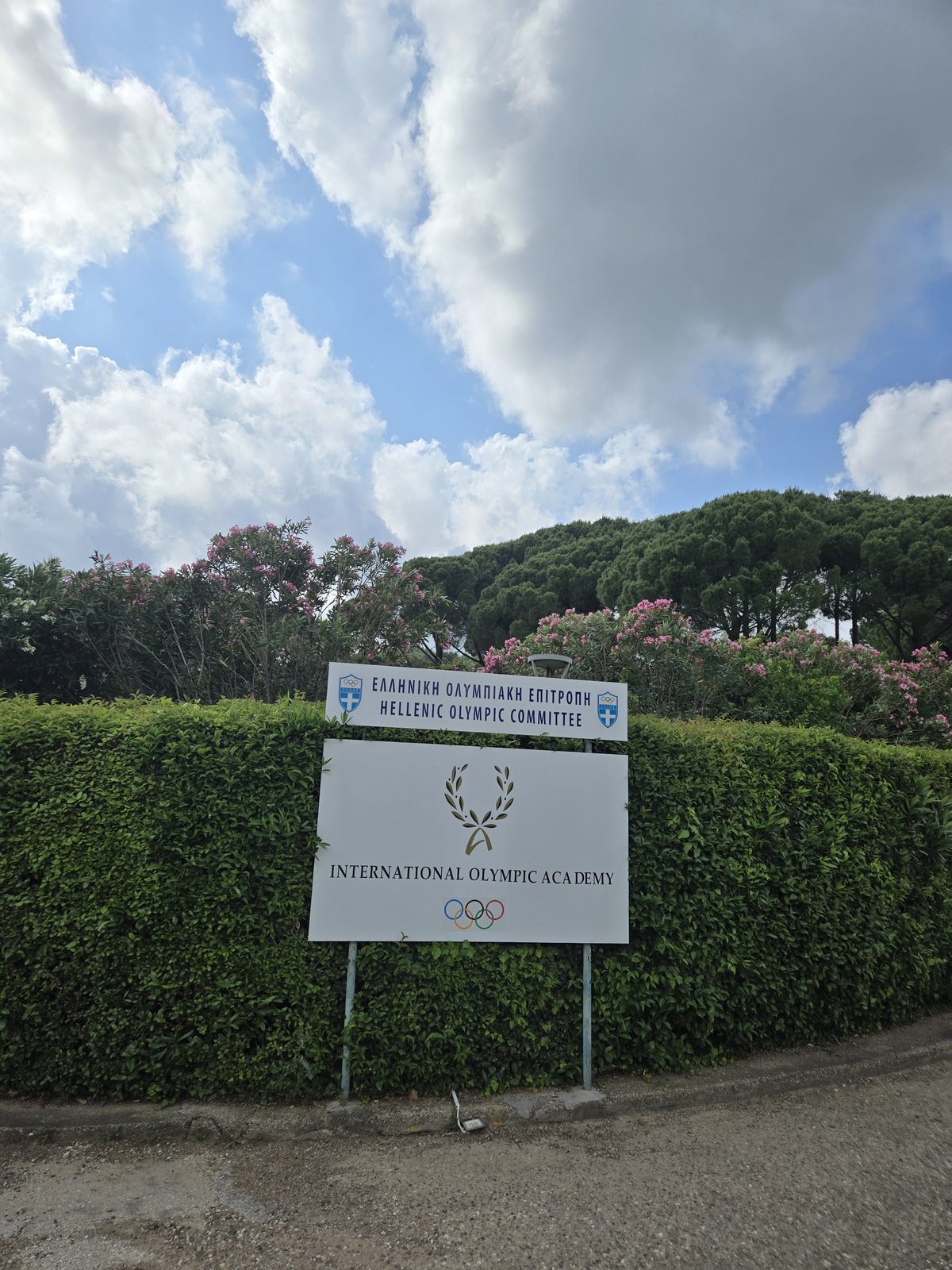
In June 2026 I had the opportunity to attend the "Wine and Olive Oil in the Mediterranean" conference in Ancient Olympia – two days during which scientists and producers from several countries came together to discuss the health aspects of olive oil. For me, it opened up a whole new world.
The year before, during my training as an olive oil taster with the ONAOO in Milan, I had focused above all on assessing an oil objectively, with a trained sense of smell and taste. In Olympia, the health dimension now moved to the foreground. Because high-quality, polyphenol-rich olive oils are increasingly seen by researchers less as a mere foodstuff and more as something close to the realm of nutrition and medicine. Still rooted in a thousand-year-old tradition, but studied with the methods of modern medicine and epidemiology.
Before I continue, an important note: this text is a report on scientific research, not a promise of a cure. The studies presented investigate correlations and mechanisms of action. They are at an early stage, and the researchers themselves explicitly draw no causal health conclusions from them. Nothing in this article is a health claim about ARÍON products, and it is certainly no substitute for medical advice.
What is officially recognised
There is one health-related connection for olive oil that is so well established scientifically that the European Union has officially authorised it (Regulation EU 432/2012). The authorised wording reads:
"Olive oil polyphenols contribute to the protection of blood lipids from oxidative stress."
This statement is tied to a condition: it applies to oils that contain at least 5 mg of hydroxytyrosol and its derivatives per 20 g of olive oil. The beneficial effect is obtained with a daily intake of 20 g. This is precisely where it becomes clear why the polyphenol content of an oil is so decisive – and why early-harvest oils from green olives, which are naturally particularly rich in these compounds, are at the centre of the research.
This EU claim is the established starting point. What was presented at the conference in Olympia looks beyond it – into areas that are still being researched.
A growing body of studies
One of the highlights for me was the overview lecture by Prof. Prokopios Magiatis (University of Athens), who summarised the scientific developments of the past year. His conclusion: the number of studies on the health aspects of high-phenolic olive oils is growing rapidly. In the past twelve months alone, 18 review articles examined numerous individual studies – from several countries and on very different questions. Magiatis also pointed out that further research is needed to confirm and extend the findings.
In what follows, I recount some of the lines of research that came up in Olympia. This is the current state of scientific investigation – not proven effects, and explicitly not statements about any particular product.
1. Cancer research: the focus on oleocanthal
In research, particular attention is paid to oleocanthal – a natural phenolic compound found above all in early-harvested, green olive oils and partly responsible for their characteristic peppery bite in the throat. Laboratory experiments investigate how oleocanthal acts on various cell types.
Important for context: the majority of this cancer research is preclinical – it takes place in cell cultures and animal models, not in humans. Such experiments show possible mechanisms of action under controlled laboratory conditions. Whether and how these observations translate to human health is thus not proven – it is the subject of ongoing research.
What drives the research here is the question of why epidemiological observations – the statistical observation of large population groups in the Mediterranean region – have long suggested links between an olive-oil-rich diet and certain health markers. However, such observational studies show correlations, not cause-and-effect relationships. It is precisely this gap that laboratory research seeks to understand.1
2. Cardiovascular health and diabetes: a study in humans
While cancer research takes place mainly in the laboratory, for cardiovascular questions there are already initial studies in humans. In Olympia, a study was presented in which the conference organisers Eleni Melliou and Prokopios Magiatis were also involved as co-authors (Katsa et al., published in the International Journal of Molecular Sciences, 2024).2
The study investigated how oleocanthal-rich olive oil affects the blood platelets of people with type 2 diabetes in the short term. Ten adults received various test meals in a controlled setup – including butter, butter with ibuprofen, and olive oils with differing oleocanthal content. Platelet activity (their tendency to clump together, a factor in the formation of blood clots) was then measured over four hours.
The remarkable result: the oil with the highest oleocanthal content showed an effect on the inhibition of platelet activation comparable to that of 400 mg of ibuprofen – and in a dose-dependent manner, i.e. stronger with a higher oleocanthal content. This fits an observation known for some time: oleocanthal acts on the same enzyme (COX) as anti-inflammatory painkillers of the ibuprofen type.
For all the fascination, the necessary caution is important, and the authors themselves state it: it was a very small study (ten people), a short-term effect and a laboratory value (platelet activity) were measured, not the actual prevention of heart attacks. The researchers therefore speak of a "possible" cardioprotective benefit and of the results supporting the concept of a "food-based" strategy – not of proof. It is a promising indication that justifies larger studies.

3. Further fields of research: joints and skin
Beyond cardiovascular health and cancer, further areas currently under investigation came up in Olympia – here the research is in part still at an early stage, but it shows how broad the interest has now become.
One example is osteoarthritis, the wear of joint cartilage. The point of connection is the same anti-inflammatory mechanism that makes oleocanthal interesting for cardiovascular research too – the question of whether this could have a favourable effect on inflammatory joint processes is being pursued scientifically.3
Another field is psoriasis, a chronic inflammatory skin disease. Here too, the anti-inflammatory aspect of olive oil polyphenols is the focus of the investigations.4,5
For both areas the same caution applies as before: these are lines of research, not proven effects – and certainly not treatment recommendations. They stand here as examples of how many directions science is currently exploring.
Between tradition and science – a personal conclusion
What I took away from Olympia is less a list of effects than a changed perspective. In the Mediterranean, olive oil has for thousands of years been food, culture and remedy all at once – antiquity revered it as something almost sacred. What is fascinating is that modern science is now pursuing this ancient esteem with its own methods: with clinical studies, laboratory analysis and epidemiology. Tradition and research meet here in a way I had not known before.
Prof. Magiatis's overview made clear that the number of investigations is growing – and that the findings so far point in an encouraging direction, without the big questions already being conclusively answered. It was precisely this honesty that convinced me: nothing is promised that is not proven, but the research is being pursued consistently.
The fact that my own oil received an award at the Olympia Health & Nutrition Awards 2026 for its content of health-protective polyphenols has reinforced me on this path, to continue to focus on early harvest and quality, even if that means a lower yield. Because one thing has become clear to me after these two days: the polyphenol content is not a side aspect, but the heart of what makes an olive oil valuable.
Sources (selection)
- Anwar MJ et al., Olive Oil Polyphenols: A Promising Approach for Cancer Prevention and Therapy. Food Science & Nutrition, 2025.
- Katsa ME et al., Oleocanthal-Rich EVOO as a Natural Antiplatelet Strategy in Type 2 Diabetes. International Journal of Molecular Sciences 2024, 25, 908.
- Review on olive & osteoarthritis ("From Bench to Bedside"), Int. J. Mol. Sci.; and BMC Musculoskeletal Disorders, 2024 (oleocanthal / PAR-2).
- Olive (Olea europaea) phenolics for the control of psoriasis via targeting SMYD2 and IL-17A. Journal of Natural Medicines, 2026.
- Efficacy of a topical polyphenol-based formulation in palmoplantar psoriasis: an observational study. 2026 (PubMed 40631809).
Note: This article is a personal report on a scientific conference and reflects the state of the research presented there. It does not constitute a health claim about specific products and is no substitute for medical advice. The only health claim officially authorised in the EU for olive oil polyphenols is the one cited above (protection of blood lipids from oxidative stress, Regulation EU 432/2012); all findings beyond that are preliminary and permit no causal conclusions.